Showing posts with label New Mexico. Show all posts

Tuesday

Chiricahua Peloncillo Heritage Days 2016

I missed the talks at this years Chiricahua Peloncillo Heritage Days but did help with one of the walks on Sunday.  Co-sponsored by the Chiricahua Peloncillo Historical Society, the walk covered the historic Catanzaro Ranch which is north of Highway 9 and the Painted Pony Resort.  Because of illness Craig McEwan and I were last minute fill ins and the discussion centered on early transportation in the valley. First a discussion of early "roads" in the valley starting with the old road, the first trail running north/south through the valley connecting native villages and used by the Spanish.  Then on to the highway that preceded the Current Highway 80.  This highway shows up on the 1917 topographic map (labeled the "Borderland Highway") lies one mile east of the current Highway 80 and crosses the San Simon with a low concrete bridge.  The bridge has no markings indicating its construction date so I compared the first topographic map of the area with satellite imagery.  Shown on the 1917 topographic map this highway and bridge also paralleled the San Simon riverbed, spanning over the lowest portion of the San Simon river.  During heavy rains the river can carry a significant amount of water as shown below in some historical images.  We followed this early highway north, now passable only with high clearance vehicles, to a homestead of one of Gus Chenoeth's offspring on the other side of low hills leading to cowboy pass north of the current ranch house.  After finishing with the old bridge and drive along this early "Borderland Highway" the group moved on to the old Rodeo Intermediate Field where I talked about the history and uses of the old airfield from its' inception as part of early commercial aviation through its use as an Army Auxiliary field during WWII, then as a private facility, and finally abandonment.  A good day all in all and I had a chance to learn, see, and explore a little more the area's history as well as sharing what I have found with others.


Craig McEwan talking to the group just below the Catanzaro Ranch house.


Looking back NW across one of "Gus" Chenoweth's offspring homestead toward cowboy pass (on the left).
Looking east at the old Highway bridge surrounded by a sea of Giant Sacaton grasses.

San Simon river flowing under the old Borderland Highway bridge.  .
1917 topographic map overlaid on Google earth showing the early highway from Rodeo and bridge location.  Rodeo is at the bottom just off the overlay
                                    Video about the Rodeo Intermediate Field

Saturday

Sights and Sounds

Some experiments with sights and sounds from the Painted Pony Resort.  I'm interested in "how people see" and sights and sounds can make a big impression so I've been exploring different ways of seeing and hearing.  Since it all about ideas and concepts and not people and personalities, the ability to present what I see and hear every day may have a positive impact on others.

The image is of a Crepe Myrtle from the from the front garden.  Using Fyuse which creates a 3D rotating view of a subject it creates an interesting presentation and coupled with recordings of bird songs captured in the mornings it provides a different way experiencing the Painted Pony Resort online.

If viewed from a smartphone, just rotate the phone to rotate the image, if viewed on a tablet or desktop computer just click and drag.


Sunday

Life at the end of the Line

The Painted Pony Resort is at the end of the line, figuratively and in reality.  Located at the very end of Painted Pony Road, the estate sits on over 750 acres of deeded land in the high desert of southwestern New Mexico.  The quiet and solitude is only broken by the occasional bird watcher, delivery vehicles, and of course guests.  The estate is also at the end of the line for DSL internet services which snakes its way in from Highway 80 and electric power which is delivered to the estates' NE corner 1.75 miles away.

The isolation and anonymity provided by the Painted Pony Resort makes it ideal for those who wish to get away from it all and find someplace quiet for a family centered reunion or other event.  The estate has helped celebrate a dozen weddings, from small intimate family weddings to those with over 100 guests, as well as hosting other group events such as astronomy and artist workshops.

As opposed to estate rentals in urban areas with distractions that reduce family time and distract from family oriented activities, the Painted Pony Resort is a place of ideas and concepts where the distractions are few and the landscape itself provides the entertainment.  While the estate has all the onsite amenities associated with urban settings, satellite TV, wireless internet, pool, hot tub, basketball, and with 13 bedrooms in 4 buildings, it is New Mexico's high desert and the surrounding mountain ranges are the real attractions. So if you are looking for a unique location for your next event, come on down for a visit.

Arriving at the Painted Pony Resort

Aerial view of the Painted Pony Resort, looking south.

Aerial view of the Painted Pony Resort, looking east.

Aerial view of the main complex at the Painted Pony Resort, looking east.


Saturday

Birding in the Boot Heel

I'm not a birder, but it is an extremely popular activity in the basin and range province of southern New Mexico and southern Arizona.  I have written about the tradition of birding in the area but I must admit, being out in the valley and focusing on landscape restoration leaves little time for birding.  But as the landscape slowly improves the avian fauna are some of the first returning animals I see.  The number and diversity of avian species has slowly increased over time, so perhaps some dedicated study on local avian species is warranted to better understand how the improvements to the land affect which species utilize the available resources.  Since the beginning the most common bird species seen on the estate was the Eurasian collared dove.  The number of doves though resulted in the appearance of raptors such as owls, hawks, and kestrels which have been seen on the estate and I find bits and pieces of doves on occasion indicating a successful hunt.  Since collard doves are an introduced species, I do appreciate the assistance of these raptors in controlling their numbers.  Most recently, a northern harrier has been hanging out and can be frequently seen hunting in the grasslands towards the riverbed.

Below is a another new comer I saw for the first time on the estate, a female Ladder-back woodpecker, Picoides scalaris. Checking online birding sightings, this should be common species around here though the closest sightings are reported from Highway 80 about 1.5 - 2 miles further west.

Female Ladder-Back woodpecker at the Painted Pony Resort.

Sunday

Growing the Art

The big spaces in the valley call for big art works, but with no training in the arts it is difficult at times to create artwork that does justice to what I see and experience.  But it is still up to me and the creative juices to see the possibilities then create something.  I have talked about growing artwork in the desert previously and I finally got this years yucca stems that had been trained and shaped, harvested.  This multi-year project, like the landscape restoration, takes time and patience to see any results and it is pleasing when an idea works and adds to the ambiance of this high desert valley in New Mexico.

Spanning a period of 6 months the photographs below are of a single yucca stem that was persuaded to circularize, with bailing wire, while it was growing.  After blooming a cactus wren found the shape attractive and built a nest within the circularized stem.  Now abandoned, the finished stem was harvested and placed with others as another stay in the fence line at the entrance to the Painted Pony Resort.  While other yucca stems did not turn out as well their curving stems will also be added to the fence line with the idea of creating an entrance area that is inviting to guests after their drive to reach the estate, as well as holding the fence wire in place.

Yucca stem in training.

Trained yucca stem in bloom

The same yucca stem after drying and ready for harvest.
Yucca stem fence stay.

Bicycles at the Painted Pony Resort

Bicycling is a popular past time and several posts on bicycling in and around the area were previously posted, see here and here.  In addition, several visiting bike tours have stayed at the estate while passing through the area, for example see here.

Recently a group of guests wanted to ride bicycles during their stay, but the closest bike rentals were in Silver City.  A trip to Silver City by the event coordinator (Michelle) solved the problem but something closer to home was needed.  So in response to this popular recreational activity and to accommodate guests the Painted Pony Resort now has 4 bicycles available that guests may rent during their stay if they wish to enjoy some local bike rides.  These SR SUNTOUR bikes are available in 3 sizes, a 17', 2 - 19", and a 21" bike are now on the estate.  These bicycles are designed for off road usage with 26" x 2.0" tires and front shock absorbers.  With 7 gears any grade or hill should be easily attacked and conquered including ranch roads on the estate as well as trips into the Chiricahua Mountains.  For a nominal fee the whole family can get out for some riding on and off the estate and enjoy "seeing" the area from a different vantage point. 

Bicycles are now available for guests at the Painted Pony Resort.
Ranch roads (in yellow) at the Painted Pony Resort.

Friday

More Honey Bees

I was weeding down by the hanger the past couple of days and while moving waste to create more topsoil restoration barriers I came across another bee hive out in the desert.  Unlike the other hives that tried to establish themselves on the estate this was in an abandoned burrow.  It was well established with 4 large combs visible at the entrance.  Most of the bees were laden with pollen and a constant stream of bees could be seen entering bringing more.  The hive was not aggressive though I did wear the bee suit to get photographs.  The bees seemed more interested in getting their pollen offloaded and stored for winter rather than bother with a silly human trying to take pictures.  I hope this hive survives and is not raided by other wildlife it would be nice to try and transplant the colony to the bee box in the riverbed next spring.

Abandoned burrow with honey bees flying in.

A closer view of combs inside burrow.

Up close and personal with the honey bees.

Monday

The Experimental Control

Every experiment in science has a control which can be thought of as a test where nothing is done, no treatment, no manipulation, really just a base line for the experiment allowed to run concurrently with experimental treatments.  The grassland restoration project at the Painted Pony Resort has an experimental control.  It is an area marked off by railroad ties at the north end of the property enclosing an area of about 12' x 12'.  This area started as bare earth when the main complex was built and the former estate manager placed the railroad ties to create a planting area but did nothing further.  I have left this area alone to see what would happen if there was no intervention on the landscape (only cutting back tumbleweed occasionally so I don't get any 5' high plants).  While it may appear I have not been diligent in keeping the area free of weeds and other woody shrubs this plot shows what happens if a barren area is left to naturally recover.  The plot is dominated by tumbleweed but also has woody shrubs including mesquite, Indian tea, amaranth, and rubber rabbitbrush and 1 unidentified thick stemmed weed.  Two species of annual grass have grown and one species of a perennial bunch grass has appeared but little else.  This suggests that a passive management strategy of only removing grazers and allowing the land to rest for several seasons is no longer adequate for the landscape recovery when starting from bare ground.  Rather it takes an active management strategy to restore the grassland in this heavily modified desert landscape.  For the estate that means interventions to manage water, soil, vegetation, and animals. 

The question arises as to why simple rest no longer appears to be adequate to recover the grasslands on the estate.  Several factors may be involved with the appearance of only a single perennial grass within the test plot shown below.  It may require longer periods of rest (a couple of years is not sufficient) to recover grasses within the test plot and is a reflection of my inexperience with restoration in the desert.  Or it may be a result of succession in the grassland, that is with enough time the perennial grasses will out compete the other plants.  Or it may be related to changes in climate.  About 20 years ago The Portal Project (a long term desert ecology project in the area) published a paper on the changes within their test plots, noting a shift from grasses to woody shrubs within their enclosures they suggested changes in rainfall were resulting in a shift away from grasses and to woody shrubs.  The Malpai Borderlands group also noted this shift away from grasses and towards woody shrubs with the exclusion of grazers and the loss of fire as a tool for managing grasslands, see their historical photo archives and click on a tag to view historical and recent repeat images.  Changes in climate, especially short term ones, have a particularly large effect on minimally productive desert landscapes and periods of drought in combination with human activity are known to have altered the landscape particularly the drought of 1891-93 in the area.  But are long term changes also having an effect?  Changes in rainfall patterns, especially increasing winter rains favor woody shrubs over perennial grasses making it more difficult to restore grasslands and is one reason the river bottom grasses are currently isolated so grass seed production will continue unabated.  The yearly mean temperature in New Mexico has increased 2 degrees since 1970 and marginal landscapes like the high desert may be the first to respond this change.  Whatever the source it is clear that active management as opposed to passive management techniques are required to create and sustain a productive landscape.

Control plot of vegetation with out any intervention.  Tumbleweed predominates followed by woody shrubs.


Sunday

Rubber Rabbitbrush

The landscape restoration efforts at the Painted Pony Resort continue and new challenges constantly arise.  One of these revolves around the idea of succession, that the desert plant communities on the estate are in flux either as a result of changes in climate or more directly the result of past human activity.  The idea of secondary succession in restoring the grasslands had not occurred until a close examination of the test restoration area showed a majority of woody shrubs.  In areas where all the topsoil was lost, Rubber Rabbitbrush, Ericameria nauseosa, is one of the species that first covers the area as topsoil is rebuilt.  In areas around buildings where this species has colonized and was later removed have now returned to grasses supporting the notion that plant community succession is occurring in areas where active restoration activity is occurring.  Previous work at the Portal Project suggested in a paper that a landscape wide reorganization was occurring as a result of climatic changes.  Specifically increased winter moisture which favors the production of cool season active C3 shrubs at the expense of warm weather C4 grasses was responsible for changes observed in their fenced test plots.  So there seems to be 2 alternatives with respect to the appearance of  Rubber Rabbitbrush, either it is symptomatic of a reorganization or that its appearance is related to active landscape management and is part of the natural succession that accompanies landscape restoration on the estate.

Rubber Rabbitbrush rapidly colonizes burned areas and is useful in preventing soil erosion.  Its' woody stems contain a natural rubber compound, hence the common name, but is not economically viable as a rubber source.  Nor is it particularly useful as forage but does provide pollinators a late summer source of nectar and cover for birds and mammals. Another useful feature is that it does not compete well with native grasses and over time will be replaced through competition.  While the density of Rubber Rabbitbrush varies across the landscape it seems to do best (the largest stands) where water collects suggesting it has a higher moisture requirements when compared with native grasses.

pre-monsoon view showing protected versus grazed land.  Note the quantity of Rubber Rabbitbrush in ungrazed areas.


Rubber Rabbitbrush

Rubber Rabbitbrush in bloom, note the small yellow flowers

Stand of Rubber Rabbitbrush around a grey water drain.

Thursday

It's Raining, but not here

One characteristic of the monsoon season in the high desert is uneven rainfall.  It will be bone dry at the Painted Pony Resort but pouring buckets some place else in the valley or in the mountains.  The last time this effected the estate was when it rained in the Peloncillo mountains but the estate received only 0.05".  The water from the Peloncillos funneled through the estate tearing out and moving a 30" x 20' diameter culvert.  While out working yesterday I noticed a monsoon storm building to the south and took the panoramic image below.  A single isolated area of falling rain was visible.  Upon checking the radar to see if it was moving north I noticed that what I viewed outside was actually occurring 27 miles south of the estate, down by Paramore Crater and in the San Bernardino Valley.  Since this is across the drainage divide all the rain water was headed south.  But it nicely illustrates the idea that you can see forever in the San Simon Valley.  I should say that the monsoon faded then built again and the estate received 0.61" overnight, bringing the monthly total to 4.81" for this monsoon and a yearly total so far of 8.35".


The main house and guest house at the Painted Pony Resort with an isolated monsoon storm in the background


Screen grab of the radar image showing the location of PPR and the isolated monsoon storm shown in the photograph.

Sunday

Cloudscape

Arising before sunrise has some advantages.  Frequently during the high desert's 2 rainy seasons the morning clouds take on special shapes and colors creating breath taking views.  Below are 3 images of sunrises from this past winters rainy season.  The first 2 taken at sunrise through Antelope Pass in the Peloncillo mountains of southern New Mexico.  The wispy yellow cloudscape was a pleasing way to start the day.  While the last image is the sunrise of Christmas morning 2014.  The range of color, purple through yellow, contrasting with the cloud texture from smooth to well defined clouds is especially pleasing.  Sitting in my files, I recently rediscovered these images while cleaning and wanted to pass along these awe inspiring views of sunrise in the high desert of New Mexico.


whispy clouds
Sunrise through Antelope Pass in the Peloncillo Mountains.  Note the mimetolith in the lower right corner.

Cloudscape of blue and yellow
Christmas morning cloudscape

Wednesday

Selective Color Desaturation

Contrast and color are important aspects of any photograph and I always struggle to find the right mix that produces depth and helps create an interesting image.  One method which mixes both color and contrast manipulation is selective desaturation.  This method relies on the removal of specific colors during the post production process either by painting out color in certain areas or the wholesale removal of certain colors from the photograph.  By selectively removing individual colors from the image a composite of Black & White and color is created.   Below are 3 images, the first is what came out of the camera.  The second is with the mountains, clouds, and sky desaturated.  While the third is one in which the foreground appears desaturated while the mountains, sky, and clouds retain their color.  This simple technique can add a great deal to an image and help enhance specific aspects of an image.

Full color image

Sky and mountains desaturated

Foreground desaturated

Friday

Puddles of Pink and Other Stuff

Below is a nice sunrise through the Antelope Pass in the Peloncillo mountains of southern New Mexico.  Pink puddles of light illuminate the edges of cumulus clouds at dawn. Closing in on the end of a 30 hr work day, I saw this as the sun was beginning to rise.  It is followed by a view of the front garden where selective colors were desaturated to create a Black & White background with the blooming Crepe Myrtle in the foreground.  I find this image pleasing as a result of the difference in contrast afforded by the partial desaturation.

Little puddles of pink at sunrise.

Crepe Myrtle in color with Black and White mountains.
Addendum:
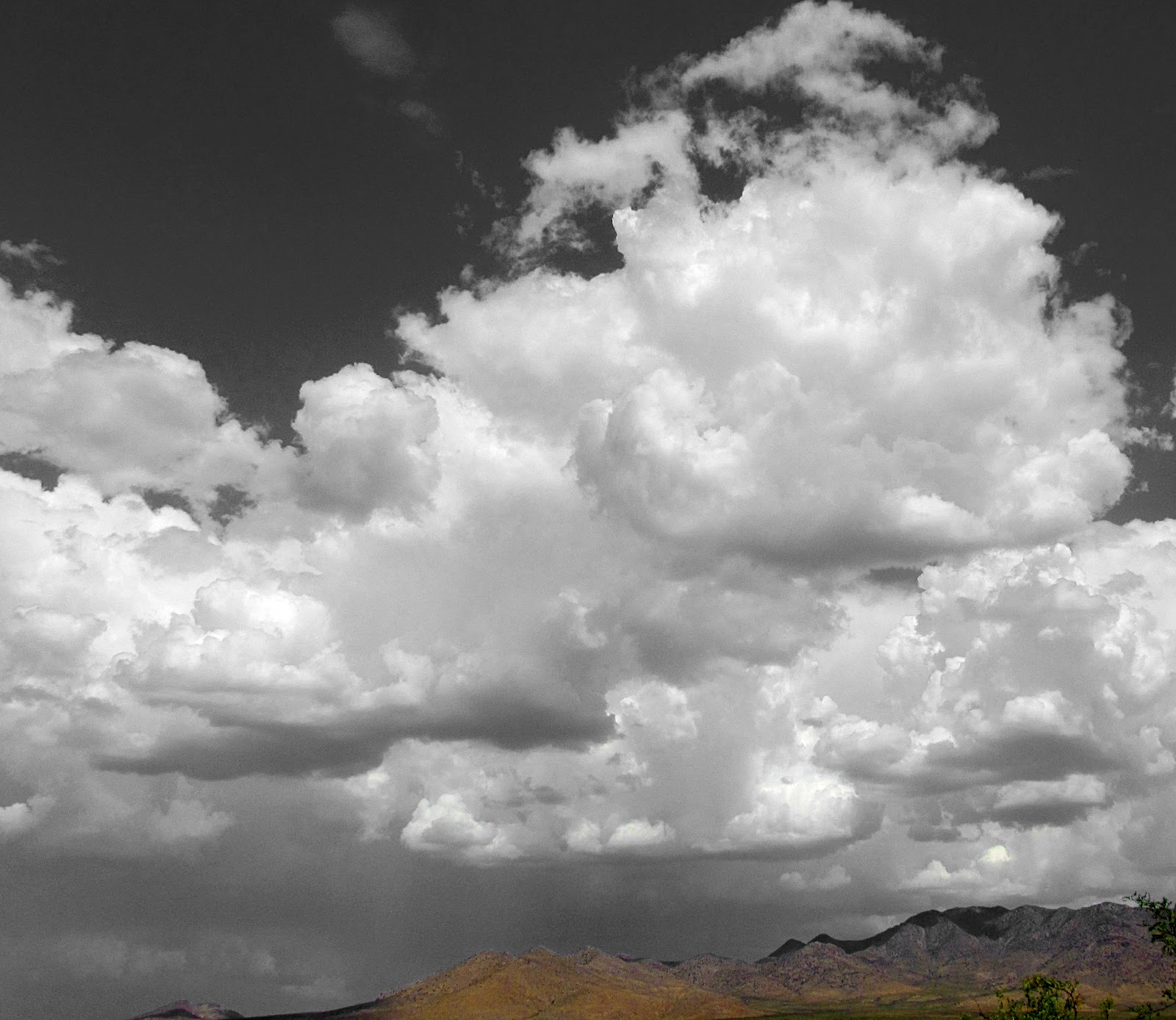
Here is one more selectively desaturated image, this time reversed with B&W predominating the image.

Selective desaturation of clouds over the Peloncillo mountains

Thursday

Same Time, Same Subject, but from Arizona and from New Mexico

The wide open western skies of the San Simon Valley just beg to be photographed and the monsoon season always brings interesting views.  Recently 2 photographers, myself and another photographer captured the same cumulus monsoon buildup independently.  We were both outside at the same time and saw the same thing although miles apart and not in communication with one another.  We independently took the same image at approximately the same time, but from completely different locations, one of us on the west side of the valley, the other on the east side.  Then we both processed our images into black and white to enhance the impact of the image before posting them.  It amazes me that we both saw the same thing, were both impressed by the view, then captured it.  And since the other photographer was in Arizona when taking her photograph, while I was in New Mexico, it makes it the more interesting to me.

My image of the cloud is somewhat larger and it could be argued that I was closer to the cloud in question resulting in a larger image, but the more likely explanation is that I used the zoom.

Cumulus build up from the New Mexico side of the San Simon Valley.


The same cumulus buildup from the Arizona side of the valley.  Photo by Statia Dougherty
Addendum:  The other photographer was shooting in Black and White mode on her camera and did not have to convert to grayscale in post production.  I do not have that option on my little point and shoot camera so an extra step is required to produce Black and White images.

Sunday

I Found a Rock

Of course your laughing after reading the title but being out on the landscape working always provides opportunities to find something new.  While driving down the entrance road on the estate the other day I noticed some new burrows along the drive, stopping to investigate I noticed a strange stone lying in the excavated dirt pile next to an entrance.  Perhaps 2" long and about 3/8" in diameter this elongated piece at first resembled a segment of root.  Upon picking it up I noticed it was stone not wood, with a crusty like exterior but a very fine grained interior.  There appeared to be a central core partially hollow at both ends.  Stumped as to its identity I put it away and went on working.  Later I started searching for a possible identity to this unusual find and came across descriptions of fulgurite or fused sand and dirt from a cloud to ground lightning strike.  The area does see many lightning strikes especially during the monsoon season and of course there is the New Mexico Lightning Field, so perhaps this is a piece of petrified lightning.  It is interesting to note that the bulk of the interior is very fine grained while the outside layer is much courser as if the interior material fused at a much higher temperature which decreased further out from the center.  Just one more reminder to keep ones eyes open when out on the landscape.  Oh, I still have not figured out what animal dug the burrows along the fence line.

Fulgurite specimen from the Painted Pony Resort

Cross sectional view of the fulgurite

What About the Other Native Bee Species?

Oops, after uploading the last post on Honey Bees to Facebook a local Biologist asked about all the other bee species native to the desert southwest.  Most other bee species important for pollination are solitary and do not form hives.  As such their nesting requirements differ from the common honey bee.  To remedy this situation several nest sites were created that cater specifically to solitary bees.  These nesting sites 1/4" - 3/8" in diameter and 3-5" in depth were drilled in left over 2 x 4s and placed inside segments of old drainage pipe.  After finishing, these nesting tubes seemed functional but sometimes functional is not enough.  Something visually interesting out on the landscape is also required.  So a grubbed mesquite was chosen and after some time with the saw a much more interesting shape for a bee nesting site emerged.  Covered in 1/4" - 3/8" holes 3-5" deep and with a rebar pin in the base this section of stump was inverted and placed on the top a railroad tie fence post at one corner of the property close to the riverbed..  The dried mesquite is hard and with a covering of bark should last many years in the weather.  By inverting the stump the nest holes are protected from the weather and by drilling holes all around the stump the bees have a variety of choices for micro-climate specific nesting sites, sun, shade, amount of breeze, choice of views etc..

For more on the native bee species please see:  Pocket Guide to Native Bee Species of New Mexico, in a pdf format.

2 x 4 and drainage pipe solitary bee nesting site.

A more visually interesting solitary bee nesting site out of Mesquite.
Functional solitary bee nesting site in place.

A visually interesting mesquite stump bee nesting site in place on a fence corner post.
Addendum:
A new website specifically about pollinators in the southwest "Pollinator Corridors Southwest".

Saturday

Honey Bees Part II

As noted in a previous post, this year has been full of honey bees.  I made the mistake of using caulk to try and seal hive entrances where new colonies of honey bees were establishing themselves.  The bees made fast work of the caulk and reopened sealed entrances requiring a layer of stucco to permanently seal up entrances.  Despite the aggravation of new colonies trying to establish themselves honey bees are good for the landscape.  Reports of the decline in bee colonies is in the news prompting the Painted Pony Resort to do its' part in maintaining local bee populations.  Habitat restoration as part of the grassland restoration project is one of the goals of the resort so honey bees are a natural target for restoration activities.  To that end a 2 tiered bee box was placed in the riverbed as a home for a honey bee colony.  Under the shade of a large mesquite and with the entrance facing southeast (away from the predominate winds) the site is well suited for a colony of honey bees.  Located in the middle of the riverbed the area is surrounded with grasslands and wild native flowers.  Although I have missed this springs movement of new queens the location is ready for any wandering queen looking for a new home.

For more information on habitat restoration for Honey Bees see the Great Pollinator Project.

Honey Bee habitat restoration
A new home for some local honey bees

Tuesday

The Genesis of an Idea

Halfway between Tucson and El Paso and bypassed by I-10 one of the few surviving segments of Highway 80 still exists in the San Simon Valley.  Memorialized in Bob Wildmire's unfinished mural in the Rodeo Cafe, Highway 80 was once the major east/west auto route across the nation.  Known variously as the Old Spanish Trail, the Broadway of America, and the Overland Dixie Highway, Highway 80 brought travelers through the San Simon Valley.  Some passing through, some staying for a short while, and some staying on permanently Highway 80 was the introduction to the valley for many travelers.

With the construction of I-10 the valley was bypassed and over 18,000 vehicles/day now cross the state line on I-10, unknowing and unaware of the history and beauty that lies just south of the Interstate.  While some travelers are headed to Tucson or the coast some are headed to Tombstone and Bisbee.  Perhaps it takes just the right incentive to encourage folks to take the scenic route around the mountains on one of the last surviving segments of Highway 80 and enjoy an early piece of Americana and automotive history.

A proposed design for a billboard on I-10 promoting Highway 80.

Sunday

Without Color

Recently a post on the importance of light and color in how people "see" was posted which generated a thought.  What becomes important in an image if color is removed.  To see what happens the image below was created of an early morning cloudscape over the Peloncillo mountains.  When the colors are converted to grayscale the result is an image where differences in texture and contrast seem to dominate.  Rather than the wavelength of reflected light being a dominate component of the photograph (a phenomena external to the camera's CMOS chip) it is the internal differences within the image itself that become important to me as a viewer.  Visually exploring the color original my eye first focuses on the blue sky and not the clouds, while in the black and white image my eye is drawn to the clouds and the differences in contrast then in texture.  So perhaps underlying the differences in color are the important differences in contrast and texture which helps make a photograph interesting to a viewer.

peloncillo mountains clouds
Original multi-image panorama in color as a starting point.

grayscale clouds
Final product, an early morning cloudscape in black and white

Monday

Always Something New

It was early Saturday morning, as usual I was up and out before sunrise with a cup of coffee wandering around trying to mentally organize my day when I heard cattle bellowing in the distance to the south east.  I grabbed the binoculars from the trailer and started looking for the cattle to see if they were on the estate.  I found several head in the distance and it appeared that they were on the property.  Cattle on the property is counter to the grassland restoration underway so I loaded the Kubota with fencing supplies and headed out to find the the problem and fix any downed fence.  I checked the south fence line, all intact, then the east easement fence along the old railroad bed, all intact, and no sign of cattle.  I must have misjudged their location so I headed back to the main estate.  While on the east side of the San Simon riverbed where the ranch road passes the old Mimbres hamlet something caught my eye.  Sticking up from the ruin were 12-18" stems of a wildflower I had not seen on the estate before.  Stopping and wandering over I found a number of unknown plants in bloom scattered about the ruin so I got busy with the camera to document the wildflower and for use in identification.  I posted some images and asked if anyone recognized the species as the first step then got back to work on this years crop of tumbleweed.  That evening I was rewarded with an identification from the curator of the Louisiana State Arthropod museum identifying the wild flower as Delphinium wootonii, commonly known as Organ Mountain Larkspur or Wooton's Larkspur, a member of the buttercup family.  Found in both New Mexico and Arizona the flowers clearly are "buttercup like" and easy to spot on the landscape.  I'm constantly finding something new and amazing each time I'm out on the landscape and a big thank you to Victoria, the curator at LSAM for the identification.


Delphinium wootonii, a member of the buttercup family

Organ mountain larkspur (Wooton's larkspur)