Showing posts with label monsoon. Show all posts

Monday

Monsoon Indecision

The monsoon season is always a welcomed change, the summer rains bring the desert back to life, the greening of the grasses and new plant growth, the frantic rush of animals finding mates to start the next generation.  It is a hectic pace and that extends to the cloud formations.  Both the Chiricahua and Peloncillo Mountains go through several cycles of cloud building on a daily basis, sometimes bringing rain sometimes not.  The image below was taken one afternoon during the current monsoon season and shows the indecision often seen in developing weather during the monsoon season.  Cumulus clouds were developing just above the Chiricahua Mountains while higher up the clouds took on a runny egg appearance. The difference was the result of different wind speeds at different altitudes with higher winds at higher altitude smearing the developing cumulus clouds.  No rain resulted from this buildup but the appearance of this cloudscape was particularly pleasing.  This weather indecision culminated recently in a spectacular evening of lightning and rain.  The bottom image shows the distribution of lightning strikes in the San Simon Valley and both mountain ranges as a result of this particular monsoon storm.  Very localized and confined to a small (for the desert) area the storm produced rolling thunder constantly throughout the evening.  An image of lightning from this storm taken by Steve Wolfe may be seen here and here. All in all it has been a great monsoon season with almost 8" of rain recorded at the Painted Pony Resort.


black and white cloudscape
Two different cloud types over the Chiricahua mountains on a monsoon afternoon.

Lightning strikes from an overnight storm over the San Simon Valley and surrounding mountains

Thursday

It's Raining, but not here

One characteristic of the monsoon season in the high desert is uneven rainfall.  It will be bone dry at the Painted Pony Resort but pouring buckets some place else in the valley or in the mountains.  The last time this effected the estate was when it rained in the Peloncillo mountains but the estate received only 0.05".  The water from the Peloncillos funneled through the estate tearing out and moving a 30" x 20' diameter culvert.  While out working yesterday I noticed a monsoon storm building to the south and took the panoramic image below.  A single isolated area of falling rain was visible.  Upon checking the radar to see if it was moving north I noticed that what I viewed outside was actually occurring 27 miles south of the estate, down by Paramore Crater and in the San Bernardino Valley.  Since this is across the drainage divide all the rain water was headed south.  But it nicely illustrates the idea that you can see forever in the San Simon Valley.  I should say that the monsoon faded then built again and the estate received 0.61" overnight, bringing the monthly total to 4.81" for this monsoon and a yearly total so far of 8.35".


The main house and guest house at the Painted Pony Resort with an isolated monsoon storm in the background


Screen grab of the radar image showing the location of PPR and the isolated monsoon storm shown in the photograph.

Wednesday

2014 Monsoon Season in Southwestern New Mexico

The monsoon season is well underway and the mountains on both sides of the San Simon valley are receiving good rains.  But out in the middle of the valley it is a little slower.  The Painted Pony Resort has received about 6" so far this year and hoping for more.  Yesterdays rain was heavy in both the Peloncillos and Chiricahuas but we received only 0.07".  This morning though the views were nice and I took some time from cleaning to capture the image below.  Desaturated, the image is just one of the many faces of the Chiricahua mountains, always changing with the light and seasons.  Always something new to see.

The 8000' Portal Peak on the east side of the Chiricahua mountains

Saturday

Tarantula Behavior and the Monsoons

The arrival of the summer monsoons is always a big event in the high desert of New Mexico.  Working with the law of the minimum the rains awaken the desert and the wildlife explodes across the landscape.  From the emergence of frogs and toads singing for mates at ephemeral pools to the ants on their mating flights, the desert suddenly becomes alive with the rains.

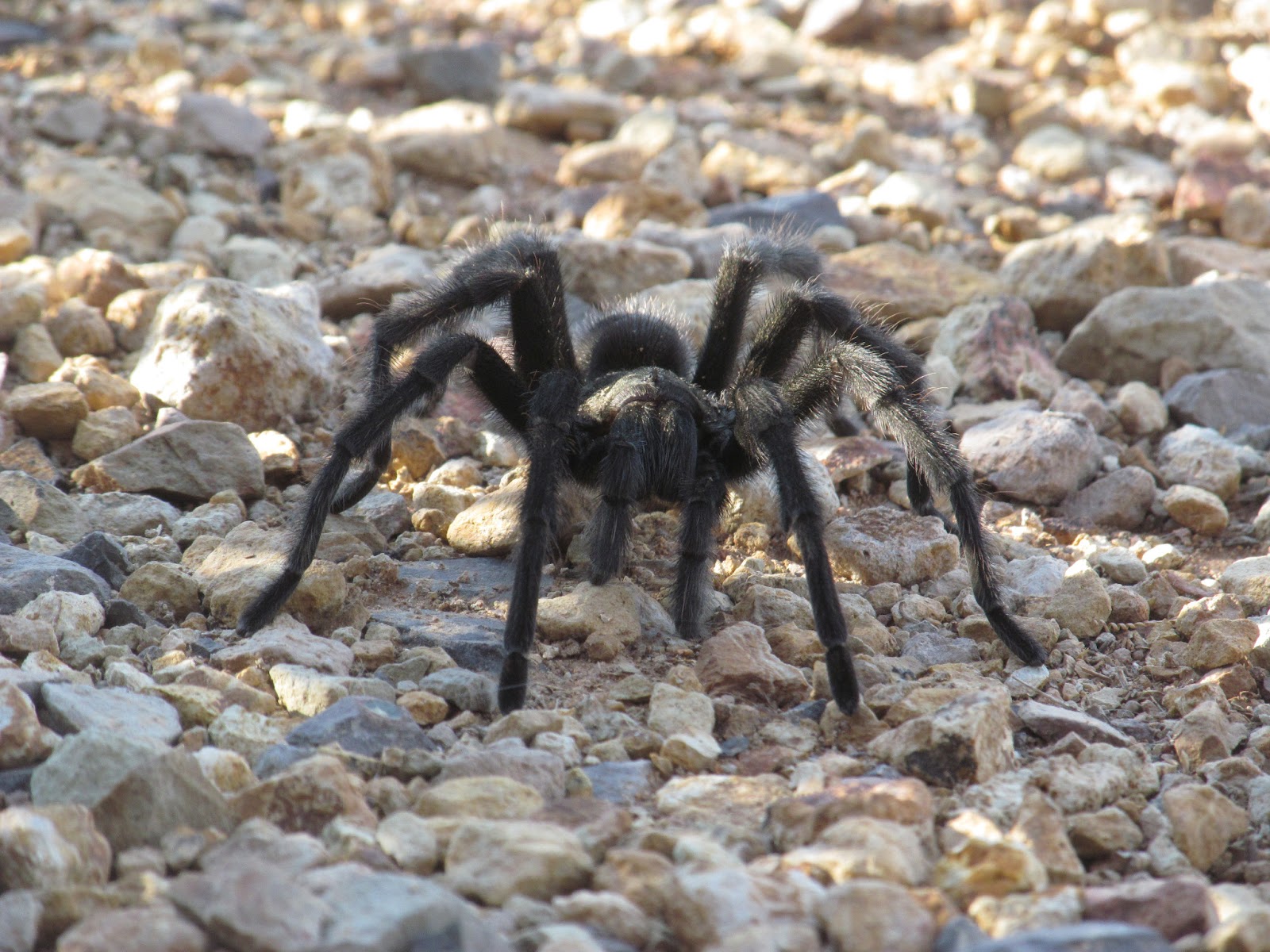
One of the species visible on the landscape are the tarantulas (Aphonopelma sp.).  A large female has maintained a burrow by the garage for years, and is always a good indicator of monsoon season.  She digs herself out every year and can be found mating just before the start of the rains, (video).  A second female has established a burrow about 100 ft away by a concrete pad and both have mated several times this year with local wandering males.

A new behavior was observed in these insects with the first significant rain of the season.  The estate received 0.15" the other afternoon and while out wandering in the rain both females were observed sitting partially outside their respective burrows, see images below.  Curious as to this behavior observations continued (yes, I was standing around in rain watching insects).  Seeing females out during the day is unusual and their position suggested they were either blocking their entrance from the rain or funneling water to drink.  As the rain subsided the female by the garage emerged completely from her burrow, circled the entrance, and went back inside.  The other female also retreated into her burrow after the rain stopped.  A single male arrived approaching one of the burrows, but the female did not respond or emerge, so the idea of a mating behavior was discarded and it was concluded that the entrance sitting behavior was not associated with mating but rather related to the rain.

Several days later the estate received another rain, 0.53".  This rain came in several waves.  The first (0.03") did not elicit any response from either female and they stayed well inside their burrows.  The second wave of rain (0.13") was rapid and flooded the entrance to one burrow but at the other burrow the female could be seen in throat of the burrow but not partially emerged as noted during the previous rain.  During a lull in the rain the burrow that was flooded was again open and the female observed sitting in the throat of the burrow.  With subsequent waves of rain neither female repeated the partial emergence behavior but continued to sit in the throat of their respective burrows.  Though after the rain one female did completely emerge and circle the entrance before reentering and disappearing, see last image below. 

It is still not clear whether the entrance sitting behavior is related to capturing water for drinking or a burrow protection behavior.  But it is clear that Tarantulas also like the rain.

female tarantula sitting at the entrance to her burrow
Female Tarantula by the garage.

female tarantula sitting in the entrance during a rain
The newest female Tarantula sitting in her burrow.

tarantula behavior
Female emerging after the rain

Friday

Monsoon Moon

The full moon has many names ranging from a Blue moon to a Wolf moon, but there is no Monsoon moon.  In celebration of the spectacular monsoon season the area has experienced this year it seems reasonable to add a Monsoon Moon to the list of full moons.  The Painted Pony Resort received another half an inch of rain last night but upon going out side this morning the view was a cloudless sky with the full moon setting over the Chiricahua mountains.  Bathed in light from the rising sun, the exposed rock of the Chiricahuas turned red and yellow and which contrasted against the green grasses of the eastern slopes.

chiricahua moon
The full monsoon moon setting over the Chiricahua mountains

Rainbow Friday

Awoke before sunrise and upon stepping outside was greeted by a spectacular double rainbow with Portal Peak and the Chiricahua mountains in the background.  Although overcast, there was a patch of blue sky on the eastern horizon allowing light from the rising sun to refract through the light misty rain creating this gift as a way to start the morning and celebrate the arrival of guests at the Painted Pony Resort.  The monsoon totals are 5.65" and it is not over yet.

new mexico monsoon
Double rainbow in the San Simon valley

Sunday

The Annuals

Wildflowers bloom after the rains, meaning a period of blooming after the winter rains in the spring and again during the monsoons.  This second round of blooming annuals in the valley is again underway and below is a species found blooming this morning along the driveway at the Painted Pony Resort.  Several specimens were found growing in association with a particular desert brush of unknown taxa.  Not being well versed in the native flowering species it is only possible to appreciate the color and beauty of these summer flowers while they are on the landscape.  If some one recognizes the species I would appreciate learning its' name.

blooming annual in new mexico
Blue annuals at the Painted Pony Resort

blue wildflowers
Wildflowers in the desert
Addendum:
A helpful reader, a local botanical expert, identified the plant as a Day Flower.  Thanks to Barbara for the ID.

Saturday

Monsoon Green

Although only receiving about 3" of rain in July, the grasslands are greening up nicely at the Painted Pony Resort.  The change in the landscape is dramatic with knee high green native grasses going to seed and the poppies blooming in the riverbed.  Monsoon green as a color is familiar to most visitors since they are surrounded by green plants at home.  But in the open desert shades of brown and red are predominant many times of the year.  The color change occurs with the winter rains and the summer monsoon rains.  The landscape changes dramatically shifting from the reds and browns to bright green as new grasses emerge and perennials green up, actively photosynthesizing in preparation for flowering and seed production.

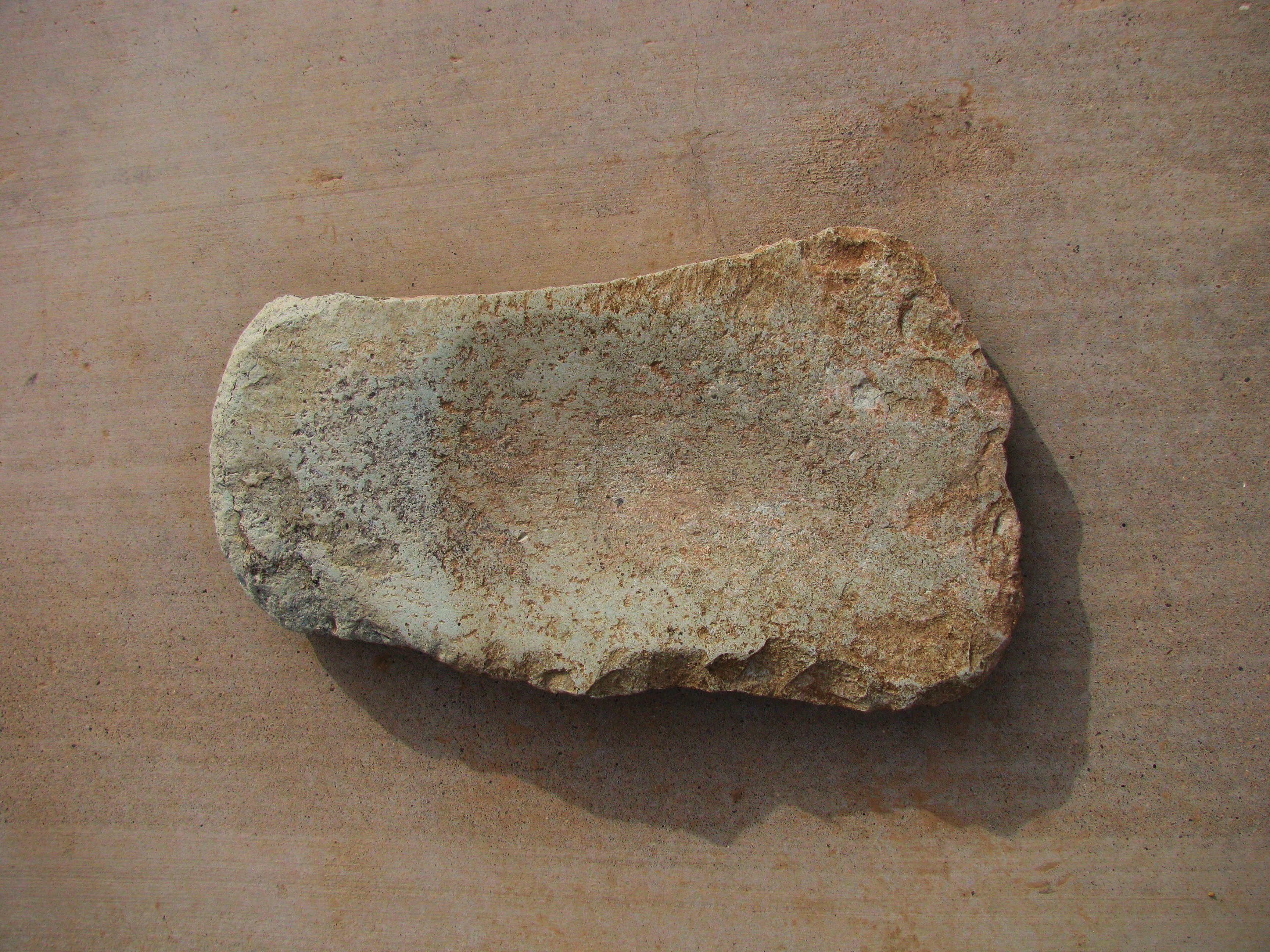
This dramatic change can be startling, but has this dramatic seasonal change always affected residents in the high desert of southwestern New Mexico and is there any evidence to support this notion?  Personal observations of the landscape suggests former inhabitants also appreciated monsoon green.  From the use of green turquoise for jewelry to the production of manos (not shown) and metates from green rocks (see below), green was and continues to be a color of renewal in the desert.

Grasslands at the Painted Pony Resort

Granite peak from the San Simon riverbed

Portal Peak from the San Simon riverbed

green stone metate

Tuesday

Monsoon Clouds

With over 300 days/yr of sunny skies in New Mexico, clouds are a big deal.  Clouds signal the monsoon and are hopeful signs of the summer rains so important to renewing the landscape and providing water to the aquifer on which residents depend.  On an active monsoon day clouds begin forming early, frequently just after sunrise, they build and scattered rains can be seen around the valley.  These clouds dissipate and sunny skies return.  Later in the afternoon the process begins again.  Clouds begin to build, frequently over Portal Peak, and a second round of showers begin which last till after dark.  These moisture laden cumulus clouds are illuminated by the setting sun creating stark contrasts of light and shadow which stretch across the valley creating beautiful sunsets.

monsoon cloudscape
Monsoon clouds over the San Simon Valley

Monday

A Different Monsoon Pattern

This years monsoon pattern seems different.  Monsoon season moisture comes from the south and west with the storms coming from the same direction, but this year the storms are coming from the north and east.  While this pattern is producing good rainfall it is something different.  A 30 year resident commented on the change in the storm pattern but was also pleased with the results. 

Another lightning display was visible over the Chiricahua mountains the other night and below are some images from the storm.  These partially desaturated images of the storm provide a snapshot of the beautiful night time displays residents of the San Simon Valley and visitors to the Painted Pony Resort can expect during monsoon season.


Wednesday

It's Better Than Fireworks During the Monsoons

Fireworks, though legal in New Mexico, are often banned on the 4th of July because of the danger of inadvertent fires during the pre-monsoon dry conditions.  But mother natures displays are always legal and frequently much more spectacular and interesting.  The local lore holds that the monsoon season begins on the 4th of July and this year was no different.  PPR has received about 1.5" of rain since the 4th and last nights monsoon brought an exceptional lightning display over the Peloncillo mountains bringing 0.42" of rain to the Painted Pony Resort.  Guests were out on the patio watching nature's display and the oohs and aahs were audible across the estate with each new lightening strike.  Although the estate, as well as the surrounding valley lost power for several hours, the lightning display was a worth while event to witness.  Several lightning photos were captured before the rain arrived at PPR and are shown below.  Of course all the really great lightning strikes occurred while the camera was cycling after each photograph, but out of about 75 images 3 caught some of the action.

A looping lightning bolt, coming down but going back up

A double hit in Antelope Pass

A single lightning bolt over the Peloncillo mountains

Sunday

The Desert Comes Alive: Tarantula (Aphonopelma sp.) Mating

With the beginning of the monsoon season the desert comes alive, the rains bring moisture and the plants and animals immediately respond.  The most recent wildlife observations were of a female tarantula, Aphonopelma sp., that has had a burrow by the garage, north of the main buildings, for several years, see here and this video.  There were no signs of the female last year and the entrance to her burrow had filled in.  Thinking she had moved to greener pastures I was surprised to find the other day the burrow entrance open with webbing across the top, but still no signs of the female.  This morning all that changed.

Upon heading over to the garage to get the Kabota out in preparation for work I noticed a male tarantula in the drive behind the Kabota.  Surprised at the find I checked the burrow entrance and noticed even more webbing across the entrance.  I went back for the camera and took several photographs of the male and returned to work.  Checking on the trantula 20 minutes later I saw a second male was approaching the burrow from a different direction stopping and tapping the ground with his legs as he approached the burrow, and so it was back for the camera again.  Upon returning the female had emerged from her den and she was battling the new comer while the other male sat quietly behind the Kabota several feet away.  The big brown female chased the new comer male around a concrete block and he took off to the south across the drive abandoning any hopes of mating.  The female then returned to her burrow and entered while the other male still sat quietly by.  After another 20-30 minutes I checked again and the other male had also left the area leaving the female in peace.  Either I missed this years mating or the female just was not in the mood.

Location of 2 male tarantulas and the female's burrow

Male tarantula waiting

Face off between a male (left) and female (right) tarantula

Female tarantula outside her burrow (third season she has been observed)
  Addendum:

Several mornings later another male approached the female's burrow.  She eventually emerged herself and after several less than positive interactions chased the male away and re-entered her burrow.

mating ritual of tarantulas
Female tarantula emerging from her burrow to an awaiting male

Monsoon Season

The monsoons finally arrived at the Painted Pony Resort.  After a few light showers around the 4th of July there was no measurable rain at PPR until yesterday when the facility experienced a good summer monsoon downpour.  Although lasting only about 30 minutes it brought between a half and three quarters of the inch of moisture.  The rain was a welcome sight and it was frustrating watching rain fall all around the valley but not at PPR.  The desert is already starting to liven up and wildlife becoming very active.

A Monsoon Afternoon

Friday

Late September Monsoons in the Chiricahua Mountains

The monsoon season in the American southwest typically spans July through September.  This year the area has experienced a good monsoon season with plenty of rain falling across the valley and in the mountains.  Generally, the monsoonal airflow patterns slow and stop in late September.  But the other day the area experienced a great late summer monsoon.  The morning broke with clear skies but rapidly small cumulus clouds appeared over the Chiricahua Mountains.  These persisted throughout the morning, slowly growing and started producing showers in the afternoon.  It was a series of gentle rain showers across the area which were illuminated by shafts of sun light through the broken cloud cover.  It was a spectacular afternoon.


Cumulus clouds over the Chiricahua Mountains

Afternoon rain showers

Monsoon Rejuvenation

Monsoon season in late summer is one of rejuvenation.  The monsoon brings water to the high desert of New Mexico and the southwest restoring the grasslands in the valley, the forests in the mountains, and recharging the aquifer.  The down side to the monsoon season is road work.  Heavy down pours can damage local roads, especially where the road crosses a drainage, so ditches require cleaning and road surfaces must be graded to remove washboards and maintain the distribution of surface gravel.  This was a week of road work after several heavy down pours rearranged the road surface.  Side and wing ditches were cleaned and the road leading to the Painted Pony Resort graded.  While all the road work takes several days it was accompanied by an incredible rainbow yesterday evening.  Views like the full double rainbow below make all the extra work worthwhile and of course there was rain most of the night.

Double rainbow from the Painted Pony Resort outside of Rodeo New Mexico

Monday

First sign of the Monsoon

Noticed a gust front from the west early this evening and went outside to take a look and saw rain showers over the Chiricahua Mountains.  Although the weather maps show the dew point still below 55 degrees there must be enough moisture at altitude to allow rain.  The Tucson weather radar shows scattered rain across south eastern Arizona.  Below is a quick snapshot of Portal Peak showing rain.  Whether it is just virga or it is reaching the ground is unknown.  Ideally, this will finish off the Horseshoe Two Fire and new grasses will start to sprout. 

Evidence of the 2011 monsoon in the Chiricahua Mountains